
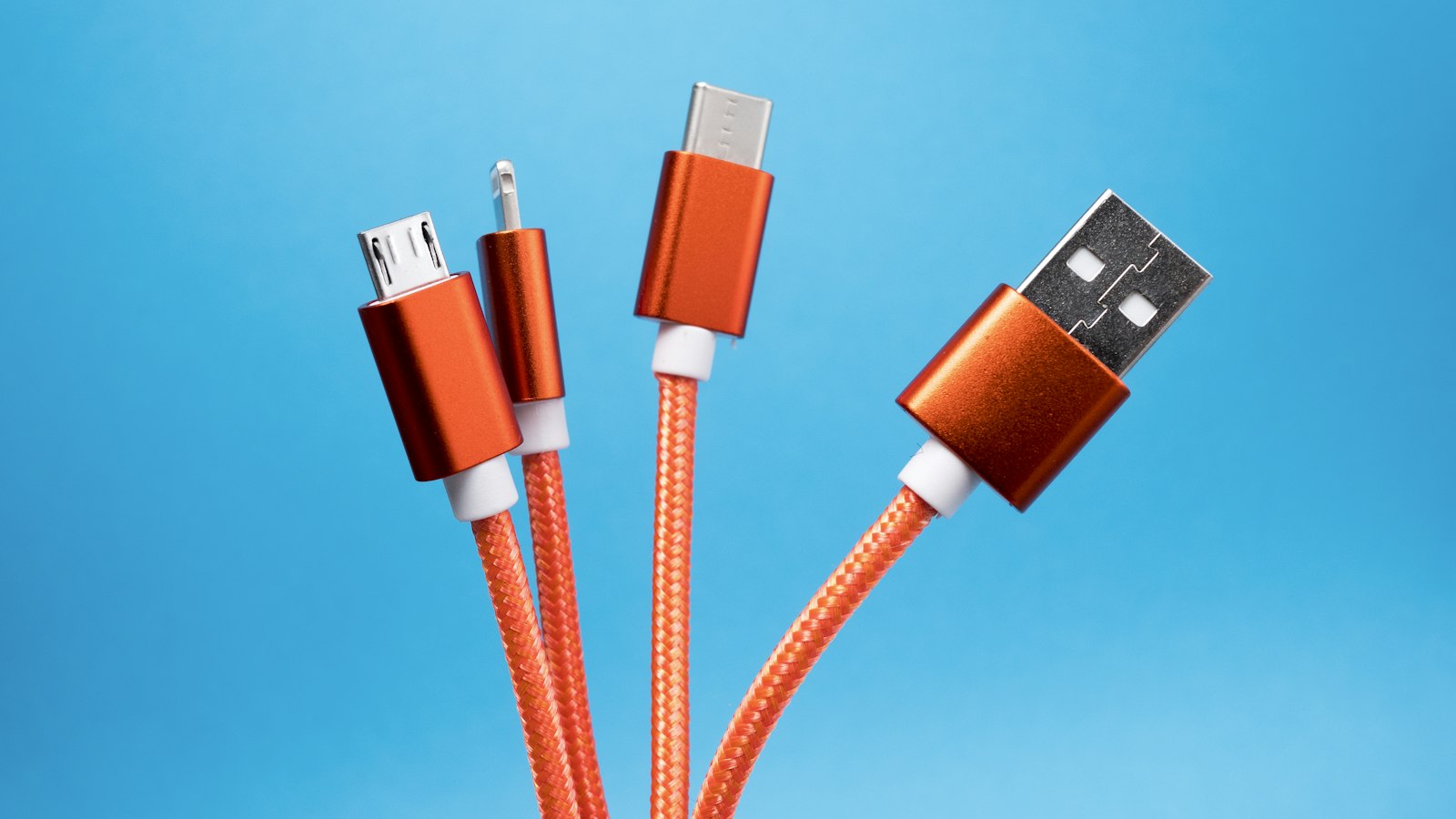
USB-C has become the universal connector for phones, tablets and laptops, but the connector is only half the story. How much power a device actually receives depends on USB Power Delivery (USB PD), the protocol a charger and a device use to agree on voltage and current. This article explains how USB PD works, what changed with USB PD 3.1, and what to look for when you specify a USB-C charger.
How USB PD negotiation works
A USB-C charger starts at a safe 5 V. When a device is connected, the two sides talk over the CC (configuration channel) wire in the cable:
- The charger (the source) sends a list of power profiles it can supply, called PDOs (Power Data Objects), for example 5 V 3 A, 9 V 3 A, 15 V 3 A and 20 V 3.25 A.
- The device (the sink) requests the profile it wants.
- The charger confirms and switches its output to the agreed voltage.
If either side does not support USB PD, the charger stays at 5 V and the device charges slowly. This is why a cheap USB-C cable or a non-PD adapter can leave a laptop “slow charging”.
Standard Power Range (SPR): up to 100 W
Under USB PD 3.0, and the Standard Power Range of USB PD 3.1, a charger offers fixed voltages of 5 V, 9 V, 15 V and 20 V. Current is limited to 3 A with a normal cable and 5 A with an electronically marked (e-marked) 5 A cable. That gives a maximum of 20 V × 5 A = 100 W.
Typical SPR chargers:
| Charger | Usual profiles | Typical use |
|---|---|---|
| 20–30 W | 5 V, 9 V (up to 3 A) | Phones, tablets |
| 45–65 W | 5 / 9 / 15 / 20 V | Ultrabooks, tablets, handheld consoles |
| 100 W | 5 / 9 / 15 / 20 V, 5 A at 20 V | 14–16 inch laptops |
PPS: fine-grained voltage control
Programmable Power Supply (PPS) was added in USB PD 3.0. Instead of fixed steps, the device can ask for any voltage in a range (for example 3.3–21 V) in 20 mV steps, and set a current limit in 50 mA steps. The phone adjusts the voltage continuously while it charges.
Why it matters: with PPS, the charger does most of the voltage conversion, so less heat is produced inside the phone. Many Android phones only reach their top charging speed with a PPS charger. If you sell chargers for the phone market, PPS support is a selling point worth printing on the box.
USB PD 3.1 and Extended Power Range (EPR)
USB PD 3.1, published in 2021, added the Extended Power Range:
- New fixed voltages of 28 V, 36 V and 48 V.
- Maximum 48 V × 5 A = 240 W.
- Adjustable Voltage Supply (AVS) from 15 V up to 48 V for EPR devices.
EPR needs a 240 W-rated e-marked cable. A charger will only enter EPR mode after the cable and the device have both identified themselves as EPR-capable, which protects older 100 W cables.
EPR brings USB-C to gaming laptops, mobile workstations, monitors, power tools and even small e-mobility products that used to need barrel-plug adapters.
How to read a USB-C charger specification
When you compare quotations, check these points:
- Total and per-port power. A “100 W” 3-port charger may deliver 100 W on one port but split 65 W + 20 W + 15 W when all ports are used. Ask for the full power-sharing table.
- PDO list. It should show every voltage and current, for example 5 V⎓3 A, 9 V⎓3 A, 15 V⎓3 A, 20 V⎓5 A; PPS 3.3–21 V⎓5 A.
- PD version and certification. USB-IF certification is optional but proves the charger passed compliance testing.
- Efficiency. In the EU and US, external power supplies must meet minimum efficiency and no-load limits (US DoE Level VI and EU Regulation 2019/1782).
- Technology. GaN (gallium nitride) switches let 65 W and 100 W chargers be far smaller. Daxpoo’s GaN charger range shows typical sizes.
- Cable. Anything above 60 W needs a 5 A e-marked cable; EPR needs a 240 W cable.
Common problems and their causes
- Laptop shows “slow charger”. The charger offers less power than the laptop requests, or the cable is limited to 3 A.
- Phone does not fast-charge. The phone needs PPS and the charger offers only fixed PDOs.
- Charger restarts when a second device is plugged in. Many multi-port chargers renegotiate all ports when the load changes; this is normal for a moment but should not repeat.
- Device charges from one charger but not another. Often a non-compliant device that relies on a proprietary protocol; under the EU common charger rule it must also work with standard USB PD.
Choosing the right platform
For most brands, three platforms cover the market:
- a 20–30 W PD + PPS phone charger,
- a 65 W GaN charger with two or three ports for laptops and tablets,
- a 100–140 W charger for larger laptops, with a 240 W EPR option where your device needs it.
Daxpoo Group’s factory company Daxpoo builds all three as OEM products with your logo, plug type and packaging. Talk to us about the power range your devices need.
